Bowery
City of GodThe Bowery, a street in Lower Manhattan, functions in the novel as the gritty, commercial underbelly of New York City where the sacred objects of St. Timothy's Episcopal Church surface in the most profane of settings. It is here, in the restaurant-supply district below Houston Street, that the Divinity Detective—the novel's narrator and protagonist—follows his intuition and finds the stolen brass cross, along with other pilfered church property, hidden among the bins of used kitchen equipment. The street thus becomes the hinge between the spiritual crisis unfolding in the churches and synagogues of the Upper West Side and the material world of commerce, where even holy objects are reduced to their exchange value.
The Discovery in the Restaurant-Supply District
The Bowery's restaurant-supply district, located below Houston Street, is described as a place where trade is brisk in used steam tables, walk-in freezers, grills, sinks, pots, woks, and bins of cutlery. It is behind the Taipei Trading Company that the Divinity Detective makes his discovery: an antique gas-operated refrigerator, too recently acquired to have a sales tag, bearing on its door the mark of his own shoe sole from when he kicked it shut. Inside the bins of the used dish department, he finds the tea things from the church pantry, white with a green trim, a gift from the dear departed ladies' auxiliary. The detective practically names his own price for these recovered items, with free delivery, calling the transaction "a steal." The scene establishes the Bowery as a place where the sacred and the discarded converge, where church property circulates as mere merchandise.
The Theft and Its Aftermath
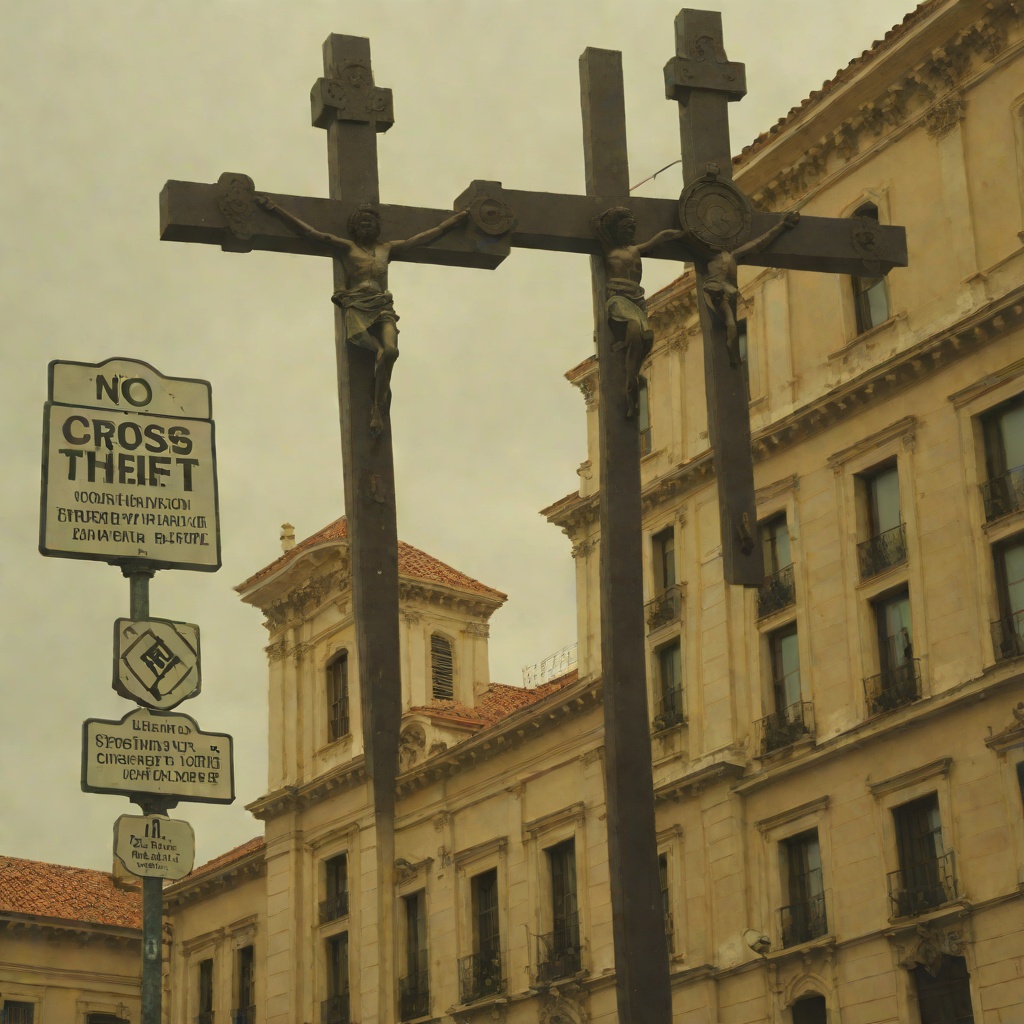
The discovery on the Bowery comes after the theft itself, which is described in terms of a shadow rising with distinction, something with right angles in the vanished instant of a turned corner. When the Divinity Detective runs back into the church, he finds behind the altar, where the big brass cross should have been, only a shadow of the crucifix in the unfaded paint of his predecessor's poor taste. A real detective from the precinct offers a cynical assessment of the crime: thieves would hit a synagogue for the Torah, which, being handwritten and not mass-produced, would bring a minimum of five thousand dollars, whereas the book value of the cross is nothing—on the street it is nothing but scrap metal. This contrast between the spiritual significance of the cross and its worthlessness as a commodity underscores the Bowery's role as the place where such distinctions collapse.
The Cross on the Synagogue Roof
The Bowery's significance extends beyond the initial discovery, as the stolen cross reappears in a startling location: lying flat on the black tarred roof of the synagogue on Ninety-eighth Street, its transverse exactly parallel to the front of the building, its upright pressed against the granite pediment. The eight-foot hollow brass cross of St. Timothy's, Episcopal, lies tarnished and shining in the autumn sun. The rabbi, Joshua Green, brings the Divinity Detective to the roof, where the latter, winded and entranced, stands against the backdrop of the old apartment houses of West End Avenue and Riverside Drive. The cross, with its old nicks and dents, has been transported from the Bowery's commerce to a position of ambiguous reverence, its placement on the synagogue roof transforming it from stolen property into a symbol of the novel's central theological questions.
The Bowery in the Novel's Larger Vision
The Bowery, as a setting, participates in the novel's broader meditation on sacrifice, suffering, and the material world. The Divinity Detective's remarks to the Bishop's Examiners invoke the image of the lizard that leaves its tail in the mouth of the predator, the fox that chews off its foot to escape the trap—programmed biological responses that prefigure the idea of sacrifice, giving up a part to save the whole. This ancient pattern, in which human beings flee monsters and escape only by sacrificing pieces of themselves, resonates with the Bowery's function as a place where things are discarded, sold, and recovered. The street's commerce in used and broken objects mirrors the novel's concern with what is given up, what is lost, and what is redeemed. In the novel's final act, the Divinity Detective's wedding prayer speaks of the monstrously evil mortifiers of humanity, the exponential murder of souls in wars and genocides, and the masses of the violently dead consigned to anonymous oblivion—a vision of suffering that finds its mundane counterpart in the Bowery's bins of cast-off things, where even the sacred becomes scrap, and where the detective, in recovering the cross, begins the work of restoring meaning to a world that has lost it.